Wednesday, 17 August 2011

July Drinks - Critic and Creative


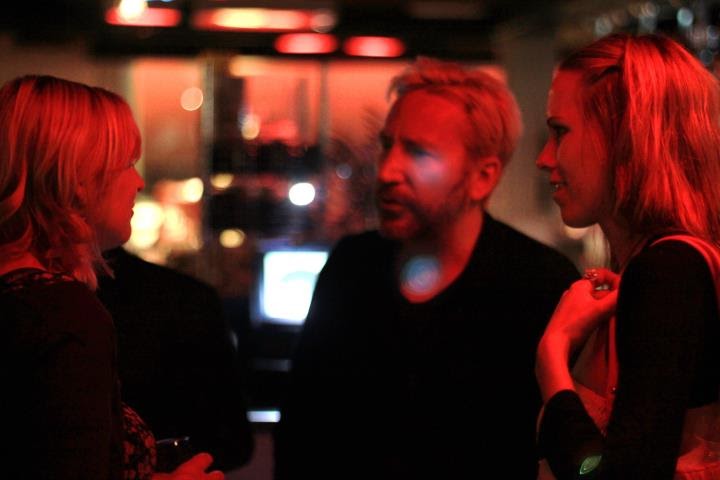
Thanks to our lovely guests this July - Film 2011 critic, journalist and novelist Danny Leigh and screenwriter, journalist and novelist Jason Arnopp. They were with us to chat about their experiences working as critics of other people’s fiction as well as creators of their own. What are the advantages and pitfalls of moving from one end of the creative process to the other?
With 20 years experience interviewing interesting types from across TV, music and film, m'colleague Mr. Arnopp has just launched a fascinating e-book called How to Interview Doctor Who, Ozzy Osbourne and Everyone Else, as well as a website for aspiring journalists. Always witty and fun to be around, (his 12 thousand twitter followers I’m sure would agree), Jason can certainly teach us all a thing or two about ‘bedside manner’. Meeting and forming relationships with such a breadth of people in the industry also doesn’t harm you when making the transition into screenwriting. A long time journalist for Dr. Who magazine, Jason now writes a variety of official Dr. Who fiction and his first produced feature Stormhouse was launched this year at the Edinburgh Film Festival.

Long time film and music journalist Danny Leigh was recently plucked from his Guardian film blog to co-host the revamped Film 2011 alongside Claudia Winkleman. Their partnership of informed everyman and passionate intellectual has already proved a successful mix. Danny has written two critically acclaimed novels and was noted as ‘a key writer of his generation’ by Dazed and Confused magazine. He is currently writing his third novel and shared with us the pitfalls of trying to keep your creative focus when juggling multiple projects.

With lots to talk about with both our featured guests we’re glad they found time to join us for a drink amidst undeniably busy schedules.

Our area of the BFI lounge was buzzing as usual with a whole host of interesting guests from the world of film and TV development and production. These included award winning writer/director Justin Edgar, currently developing new feature projects with his company 104 Films, comedy producer Norma Burke, actor Ronan Vibert, about to fly off to shoot series two of The Borgias, (with the first series of this lavish production just launched on Sky Atlantic). Also, Christina Pickworth and Steven Russell from Loves Me Not Films, Adam Polonsky from Focus Films, script editor and writer Merle Nygate and script editor Lauren Cushman among many others. We had a fantastic evening with new friends and old and look forward as ever to the next one.

 For the summer break, August’s get together will be a relaxed affair, with featured guests this time: you and us! Come and ask us what we’re up to and tell us your news. Then we’ll be back with more featured guests and events in the autumn.

Hope you can join us. Invites coming soon. x

Tuesday, 16 August 2011

TV Drama: The Writers’ Festival – Day 2

By Hannah Billingham

Plenty of time to digest Day 1; now, finally, here’s Day 2…

The curse of the scriptwriting guru?

John Yorke, the BBC’s Controller of Drama Production and New Talent, is renowned for his engaging and informative lectures on screenwriting. His Series Masterclass at last year’s festival was excellent (see Margit Keerdo’s write-up, here). This year’s session was so compelling, I almost forgot to take notes…

John Yorke. Photo by Jason Arnopp
The gist of it was: we get worked up about structure, but storytelling, and story structure, are inherent to human beings. It’s as simple as a beginning, middle and end. Jason Arnopp has written about the session on his blog: “It's hardwired into our psyches, just like morning, afternoon and night, or birth, life and death.” John also referenced the Hegelian Dialectic’s  “thesis”, “antithesis” and “synthesis”.

We were taken on a tour, from ancient Greece to the present day, via Eugène Scribe’s well-made play (the “first formula”), with the conclusion that the five act structure and the three act structure are fundamentally the same (the latter, a simplification of the former). John cleverly put the structure diagrams of several script gurus’ theories (from the ages) next to each other, to prove that they are all saying the same thing.

He concluded that while people like David Hare may disparage the “film school”/Syd Field/Robert McKee “formulae” of film structure (see photo), practitioners of every other art form takes pride in the academic study of the history of their art - and that classical drama structure is rooted in history, and in the way that human brains think.

The session ended with the quote:

“First learn to be a craftsman; it won’t keep you from being a genius.” – Delacroix

Launching a new series

This was a festival highlight, with another experienced, successful, know-their-stuff panel.

Jane Featherstone, Kudos’s Creative Director opened by saying it’s about getting the elements right, but it’s also about “alchemy” between those elements, and “luck”. She said: “it all starts with the writer”. Writer, Bill Gallagher said it “starts with the character”. Ashley Pharoah said that, in the case of Wild At Heart, premise came first, then potential for conflict, then character. It’s about having an instinct for conflict that “has legs”. And ensuring that every scene is as entertaining as you can make it.

Toby Whithouse believes you have to “give the audience what they need, rather than what they want”. Audience is broad. You can’t please everybody. It’s not about “producing something facile, in a desperate need to please”. He said he creates massive reams of character bios - digging to create three-dimensional characters.

The panel agreed that the key to a successful series is wit and humour (in terms of take on the world), and that you generally need to “get to the premise more quickly”, in episode one. They referred to the US “premise pilot” and said that In the UK the first series is the equivalent of a US pilot. Series one of Luther lacked “tonal clarity” – rectified for series two. (There’s more on this from Luther writer, Neil Cross, here.)

Ashley Pharoah said that the times he has “come a cropper” are when he has “stepped out of genre”, and that you need to know the rules of what you’re creating: the “world”, and “what it is”. In the telling of the story, you need confidence; you “have to look as if you know what you’re doing!”

Toby Whithouse said that it sounds obvious, but you should show characters “doing their thing” to set them up.

Jane Featherstone thinks that Spooks has kept going for so long because of a “let’s make the next series better” mentality. Total passion, total commitment.

Bill Gallagher wrote thirty-two episodes of Lark Rise to Candleford and absolutely loved the characters, so there was never an episode where he thought, “Oh, God… (not this).” He learned on Casualty that drama is to “create a character (and) throw shit at her.”

Other points made were: it’s about having “an iconic character you love” (for example, Gene Hunt, from Life on Mars) – one that “stands out above the ensemble”. And don’t let characters change and grow too much. An audience comes back to the characters they love. “Things aren’t fundamentally changing greatly.” (Pressing the “reset button” at the end of an episode.)

Thriller – the trojan
“Or: how to smuggle ideas and stories in under the beguiling cloak of genre.”
Panel: Frank Spotnitz, Jane Featherstone, Fiona Seres, Hugo Blick

Some gems of advice here, but my notes are a bit sketchy for this one... (If anyone can fill in the gaps, of who said what, I’d love to hear from you.)

Hugo Blick defined suspense as “knowing what is coming” and mystery as “not knowing what is coming”.

It is manipulative if the writer has an obvious intention.

Thrillers need wit and élan – we can’t get underneath dull characters.

Use the elements of the genre and spin them for your own purposes – will become fresh. Weave in truth. We need to buy into the story emotionally and believe it could happen. Heart and head.

“No tears for the writer, no tears for the viewer.” (The same goes for fun.)

“Sit forward, rip the mask off, don’t be po-faced, have fun!”

Don’t be polite; make the audience uncomfortable. And, in plotting, “don’t show the strings”. In film, “you can really see the strings” and the heart gets pushed out.

Frank Spotnitz said that, as a writer, if you don’t know how it’s going to end, it can be a good thing. He’s been in this position before on The X-Files. How will the audience know how it will end, if you don’t? You’re going to figure it out eventually, because you’ve been setting it up, subconsciously.

It shouldn’t be: “character services plot”. Should be: “only this character can experience this plot.” The perfect goal.


Adaptation
Panel: Paula Milne, Sarah Phelps, Bill Gallagher

Paula Milne likes adaptations for “not having to find the story” – and will do them if she thinks she can “bring something to the table”.

Sarah Phelps asks “why is it a classic?” and “Is it still a classic?” She’ll work on an adaptation if she has a “blood beating passion” for it, and a way to tell the story (the perspective might have shifted). Writing Nancy, in Oliver Twist, she saw Sophie Okonedo’s face. She was criticised for the choice of a black actress in this role, but in classic stories she’s passionate about asking, “who are these characters really?” - and looking at the sweep of history.

Bill Gallagher discussed the idea of adaptation as “translation” and Paula Milne said you can’t be in awe of the book.

Sarah Phelps said she’ll really kick the stories around and interrogate them – and that it’s about telling new audiences “how good these stories really are”.

Burning Questions
Ben Stephenson and John Yorke

Key points: 


People still have a hunger for shared experience. (Twitter is about “now”.)

Ben Stephenson said that what moves him is “something someone has a passion for” – he “can’t stand second guessing”. “No great idea ever born out of cynicism.”

The best script note is: “how can it be more itself?” - it's all about tonal clarity.

--------------------------------

If you haven’t been on the Writersroom website recently, it’s an incredibly useful, inspiring and highly addictive resource - and includes scripts by Writers’ Festival panellists, including Paula Milne, Danny Brocklehurst, Toby Whithouse, Jimmy McGovern, Esther Wilson and Alice Nutter.


Friday, 29 July 2011

TV Drama: The Writers’ Festival - Day 1


Launching a new series discussion. Photo by Jason Arnopp
Is there a better way to spend two days than in the company of over two hundred talented writers? I’m not sure there is. Earlier this month, I was thrilled to gain an industry place and head to Leeds to attend the second festival of its kind, organised “by writers, for writers”, through the BBC’s Writersroom


This is an excellent forum and an opportunity to discuss where the industry is currently at. Kate Rowland, the BBC’s Creative Director for New Writing, described the event as “a conversation” for writers – one that I found equally as useful, enlightening and galvanising, as a drama developer. 

Last year’s event was an inspiring occasion; this year’s felt even more so. Maybe this is a personal thing, or maybe something’s shifted socially and politically. Paula Milne gave a rousing keynote address (which you can read in full, here), during which she urged the room to “have a talent for your talent”, and to “give the audience not what they want, but what they need”. The opening panel session built on this, and seemed to sum up the mood and theme of the two days (and, I would imagine, resonate with most of the festival’s attendees, as the key reason they wanted to create drama in the first place), asking, "is it the writer’s responsibility to change the world?”

For this session (covered in more detail by Cath Bore, here), Paula Milne was joined by Tony Marchant, Hugo Blick, Jack Thorne, Roy Williams and Gwyneth Hughes.

Hugo Blick argued that we should “provoke by surprise” and “use polemic (only) when there’s real outrage… or you burn it”. 

Tony Marchant said that we need to examine the past politically, and gave the example of a drama about the setting up the NHS – how it came about, and the need to be reminded why it came into existence, and what went before.

The discussion set the mood for later in the day, when we were treated to Jimmy McGovern in conversation with Kate Rowland. “Passion” is an overused term, but his shone through. His opinions were effectively a call to arms for writers to engage their “brain and heart”. I will be compiling his many words of wit and wisdom into a separate post.

Here are potted notes of the sessions I attended. I hope I’ve attributed quotes to the right people – any corrections from attendees, please let me know. The schedule for the event was packed, so if anyone has notes on the ones that clashed with these, please get in touch and I’ll add links to these posts.

Developing different voices – representing modern Britain
Panel: Roy Williams, Hilary Salmon, Steve November and Madonna Baptiste.

The discussion focused on the representation of black and ethnic minority voices on television. Hilary Salmon said there have been big changes in policy at the top of the BBC, since Greg Dyke’s “hideously white” speech, and there have been onscreen talent changes, led by Mal Young, but what about behind the camera?

Questions raised included: Is the industry not providing a context for writers from minorities to work in? Is the stronger diversity of onscreen talent taking the onus off broadcasters, for example, to look at wider industry talent representation? Or are the writers just not out there?

Roy Williams said that the UK's successful black actors did well in America (making a name for themselves), and then came back to the UK. He believes that the trouble with writing is that it is hidden from view, so would-be writers from some backgrounds do not see it as an area that they can get into. He believes that more cultural stories onscreen will attract minority writers – in the same way that the rise of successful black actors in the UK has led to a rise in drama school applications from black talent.

We were told that Babyfather did well, but didn’t get recommissioned after its second series, and that Moses Jones was written by a white writer. An audience member remarked that they found it daunting writing characters from different cultures. Roy Williams (politely!) said that they should just “get over it” and “we shouldn’t be afraid of cultural specifics”.

Steve November said that “we need a diversity of voices”, that “producers need to actively look”, and “it has to come from the industry”. He said that there are socio-economic factors at work, as to why some sections of society can’t currently get a foot into the industry.

Broadening out the discussion to gender, in the Q&A we were told by an audience member that out of all the entries for Channel 4’s Coming Up scheme (which were read blind), nine women had been selected, and three men. It would be interesting to find out the percentages of male and female submissions to this.            

That it is 2011 and we still need to tackle inequality in terms of the backgrounds, ethnicities and genders of writing talent, and that there is still debate as to whether the talent is actually “out there”, is pretty depressing.

The biopic: – the fallback position?
Panel: Brian Fillis, Amanda Coe, Gwyneth Hughes and Madonna Baptiste

At last year’s festival, Tony Marchant said that the “BBC4 biopics of the famous eschew examination of the lives of ordinary people. Good drama tells you something about yourself. Biopics don’t do that.“ (Thanks to David Bishop for a reminder of that session, here). He argued that they were the fallback position for commissioners.

Amanda Coe, writer of Filth: The Mary Whitehouse Story (and Roy Williams, in the Is it a writer’s responsibility to change the world session, earlier), said that drama is finding out how people, characters “got like that”. Mary Whitehouse; fascists… Drama is about uncovering the “crisis point” in their lives.

Fear of Fanny and The Curse of Steptoe writer, Brian Fillis argued that biopics may be a “fallback position” for commissioners, but are an “open goal” for writers, giving you the freedom to focus on character. He gave the example of Peter Morgan focusing on two to three weeks of a subject’s life.

He said that The Curse of Steptoe, transcended being a film about Harry being typecast; becoming a film about the journey from youthful optimism, to ageing and your options becoming limited - and so was relevant to a wider audience.

Gwyneth Hughes, writer of Miss Austen Regrets, “felt the pressure of a great writer in the room.” (She is now doing Dickens – and feels the same.) She has a film greenlit about the relationship between Hitchcock and Tippi Hedren, and believes that biopics should be about the “key relationship in a person’s life” – whether that is with a person or a faith – and that writers need some perspective (that is, they can’t be a “total fan”), or “the film will become a love letter”.

Brian Fillis suggested that since the Steptoe film - and the ensuing legal issues that meant it has not been shown on television again - biopics are harder to get made, and so may no longer be the “fallback position” – because they are judged by standards of documentary production and drama production.

This session was particularly of interest to me, having recently script edited a successful biopic – and given that a large proportion of the projects I am hired to look at are also biopics. I’d be interested to know if other script editors and readers experience this high percentage, too.

Writer training: can it be taught?

Danny Brocklehurst, who started out as a journalist, and had no formal screenwriting training, was sceptical about the merits of it.

Rachel Flowerday, a BBC Writers’ Academy graduate, and advocate of the scheme, discussed how it was beneficial, stating that it provides a “lexicon” when discussing scripts, and that it is useful to be taught it. They watched films, read scripts and immersed themselves in structure. The Academy has a focus on the five-act structure (see notes in the Day 2 post, on John Yorke’s session, The curse of the scriptwriting guru?).

Esther Wilson’s route into screenwriting was through the play Ten Tiny Toes – which Jimmy McGovern saw and said was the best he had seen. (There’ll be more of his thoughts on theatre in my post coming soon.) Both she and Danny Brocklehurst have worked with him, and he is known for his mentoring of new writers.

All agreed that reading scripts, and watching other things, was a great education, while writing competitions provide a focus and a deadline.

Toby Whithouse said his most successful scripts were the ones he wrote never thinking they’d get made. He said, “Don’t write for an audience” (he expanded on this in the Launching a new series session - to follow, in my Day 2 post). They agreed that Writing is rewriting, and that you should never take the easy route in a script – as it won’t provide the most interesting solution. (Jimmy McGovern expands on this, too, in my forthcoming post.)

The quote of the session (although I don’t seem to have noted who said it...) was:

“Work with people you like, on projects you are passionate about, that raise questions you want to know the answers to.”


Friday, 15 July 2011

June Drinks - Script Editing Comedy

Another fantastic turnout for another top night…

A great big thank you to our two special guests: Andrew Ellard, Red Dwarf associate producer and IT Crowd script editor, who has possibly the best testimonial we’ve ever read (“I wish Andrew came as an app.” – Graham Linehan), and Paula Hines, who has just gone freelance after nearly a decade at the BBC, where she script edited shows like After You’ve Gone and The Smoking Room, and has amassed a wealth of excellent recommendations, herself. Both were incredibly friendly, open and knowledgeable - with an obvious, genuine love of scripts and comedy.

Thank you, too, to everybody who came along, for making it such a fun evening, including, Roland Moore, creator of BBC drama series, Land Girls, who is currently developing a comedy project; agent Holly Nicholson, from Noel Gay; Jamie Hewitt, development exec at Caveman Films; Adam Polonsky, development producer at Focus Films; Steven Russell, head of development at Loves Me Not Films; comedy writer and performer, Nathaniel Tapley; producer, Nana Hughes and script editor, Lauren Cushman.
 
Thanks also to Eleanor Ball for her write-up of the night here. We are very pleased that the word is spreading about In Development – interest in this event was high, and we have more comedy development themed nights in the works.


As promised, you’ll now find screenwriter-slash-In Development photographer Jeremiah Quinn’s profile up on the site. We think he did a fine job, in the ‘romantically’-lit conditions of BFI’s Benugo bar. Thanks, Jeremiah!


We are looking forward to our next event at the end of this month, when film journalist, novelist and co-host of Film 2011, Danny Leigh and scriptwriter, novelist and former journalist, Jason Arnopp will be joining us to discuss combining the roles of Critic and Creative. How do we move between one end of the process and the other - and is it beneficial to do both? Invites to follow soon.  

As ever, if you work in development, aren’t on our mailing list yet and would like to come along, please do get in touch!

Wednesday, 15 June 2011

May Drinks - Building Developer/Agent Relationships

A huge thank you to all who made it along last month, particularly our special guests, screenwriters' agents Tanya Tillett and Katie Williams. Both were incredibly open to questions and generous with their time, and we are thrilled that they could join us. 


Our host venue Century’s beautiful bar was a wonderful setting for the night, and we’d like to extend our appreciation and thanks to all there, too.

Sarah and I had just returned from Cannes (and I was recovering from a flat move), so this was a great chance to unwind (and escape all the boxes…), with another inspiring mix of people in attendance. These included up-and-coming producer, Maria Forsstrom, from Vita Nova Films; April’s special guest, script consultant, Philip Shelley; emerging screenwriting talent, Chris Hill, whose credits include Skins;  Eastenders script editor, Suzanne Cowie and Nik Powell, Director of the National Film and Television School, one of the UK’s leading producers, and legendary raconteur!

Photographs of the night are again courtesy of multi-talented writer, Jeremiah Quinn. When he’s not capturing images of our events, he’s building an impressive slate of screenplays – including the BAFTA Rocliffe selected The Clerk of Madras (pdf). Excitingly, we've just had news that he is currently developing his nautical thriller, Dead Reckoning, with Poisson Rouge Pictures - with Christopher Granier-Deferre attached to direct. We’ll be adding Jeremiah to our Profiles section soon, so watch this space. 

We’re also very pleased to learn that professional relationships are already forming through In Development, and would love to hear more of these stories - plus feedback on what we’re doing, and ideas for future nights. You can contact us here.

Our next event is coming very soon: we’ll be discussing Script Editing Comedy on Tuesday 28 June, with Andrew Ellard (The IT Crowd, Red Dwarf), and Paula Hines (After You’ve Gone, The Smoking Room). Check your inbox for further information!

If you work in script development, would like to join us at our next monthly drinks, and aren’t already on our mailing list, please do get in touch

Wednesday, 1 June 2011

Script Factory Development Course Offer! 16-17 June


Our friends (and former tutors) at the Script Factory have sent us details of a great, new two-day training programme for script developers, readers and producers - and, what's more, they're kindly offering In Development members a discount:


Now booking for:

Thursday 16 June & Friday 17 June

It’s true what they say: writing is re-writing.  Good script development is the single most important task for writers, developers and producers but is still the area with the least clarity about its processes. A solid understanding of screenwriting theory is essential but translating that theory into practice is not always straightforward. Each movie project raises its own unique set of challenges - of course, that's why it's fun, but it can also be frustrating and can sometimes feel like you're moving backwards.  Having worked in active international development for over 10 years, with both experienced and emerging writers, Script Factory directors, Lucy Scher and Justine Hart  have devised a brand new programme that comprehensively examines the potential problems and explores how to navigate through the tricky development process avoiding the common pitfalls and setting the next draft on course to exploit all the potential strengths of a movie idea.

This two-day course is primarily aimed at script developers, readers and producers. However, if you are a writer with a script that hasn’t yet been optioned then this course contains valuable tools for analysing and improving your own work. 

We’re delighted to offer members of In Development a 10% discount – making the price £202.50 +VAT (normally £225  + VAT).

Call Sheena on 07908 815 665 to book 

Thursday, 14 April 2011

April's In Development Drinks!


Another fantastic turnout and great mix of people with all levels of experience in development. Thanks to our featured guests Yvonne Grace and Philip Shelley who were there to share their considerable experience on the subject of script editing and producing for TV. We hope that everyone, who wanted to, got a chance to speak to them and ask questions. Here are two people you could speak to alone for a whole evening and not need any further guests! However, we were lucky enough to have a full house of top people on Tuesday, including; screenwriter and author Andy Briggs, script luminary Phil Parker, actor Ronan Vibert (soon to be seen in Showtime's The Borgias), and many rising stars of development, writing and directing.


As host for the evening (with Hannah sadly laid up with a cold), this only presented the problem of having too little chance to speak to any one individual for long enough! Let's hope that as we continue to meet monthly there will be ongoing chances to talk to you all again!

Thanks to member Jeremiah Quinn for taking photos for us on the night. More pics will be up in the gallery soon. Also look out for news of our May get together shortly and if you haven't joined us for drinks yet we hope to see you there!
 

Cheers,


Don't forget you can follow this page for news updates and if you have suggestions for guests or topics, would like to write a guest blog or get involved in some way then please don't hesitate to get in touch. This is an informal, resource sharing community for development people, so your input is most welcome!